Resources · 4 min read
Aluminum vs. Steel Ornamental Fence: Which One for Your Lot?
Both look like black iron from the street. The differences show up in rust, stiffness, and price, and in where on the property the fence goes.
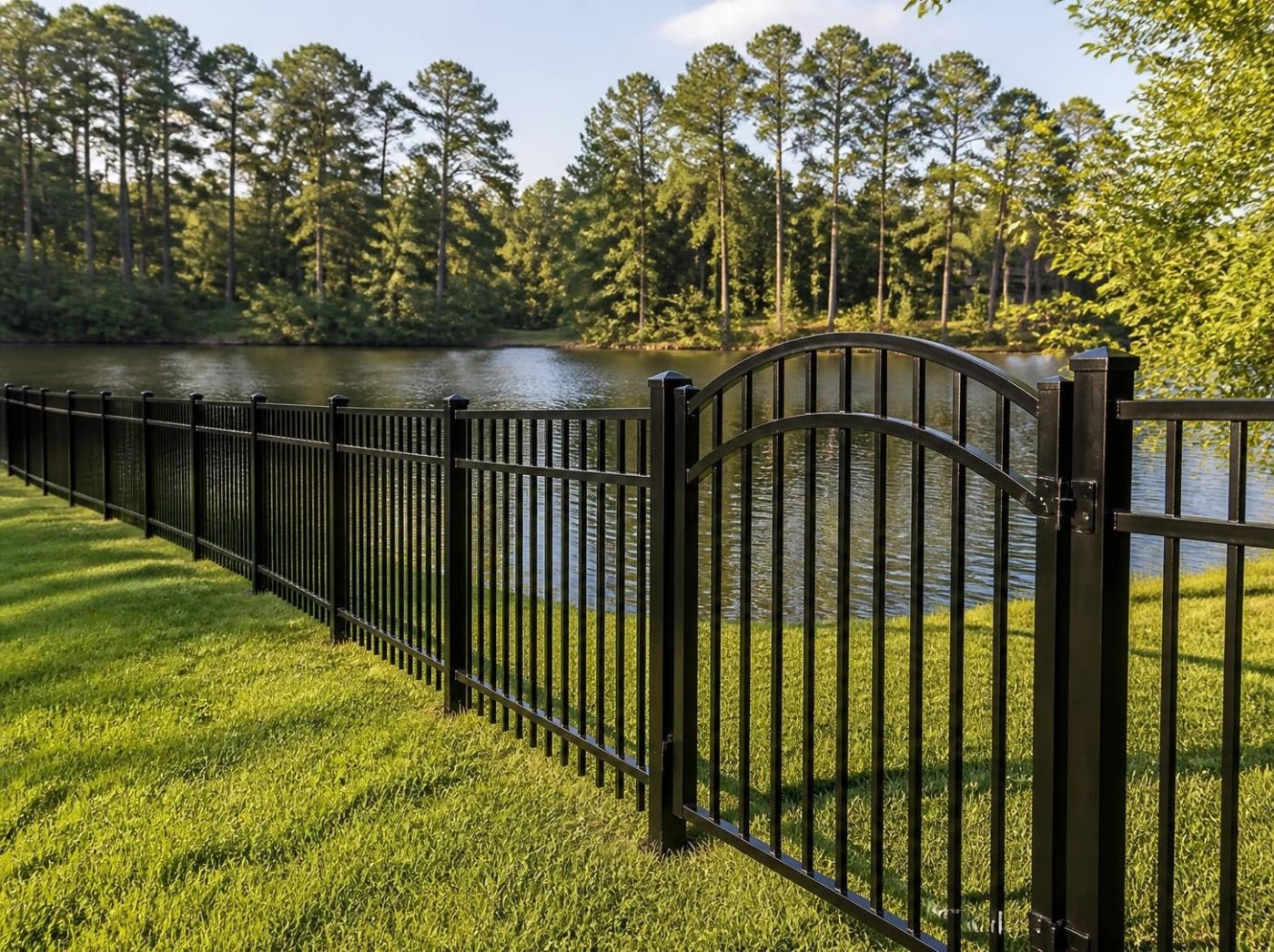
From the street, an ornamental aluminum fence and a powder-coated steel fence look almost identical: black pickets between rails, with a flat or spear top. People call both of them wrought iron. Up close they behave quite differently, and around Conroe, where so many lots face a lake, a pond, a fairway, or a pool, the choice comes up on a lot of estimates.
Here is how the two compare, and where we tend to use each one.
The quick comparison
| Factor | Aluminum | Powder-coated steel |
|---|---|---|
| Rust | Can’t rust | Rusts where the coating is chipped |
| Stiffness | Lighter; can bend under a hard hit | Heavier and more rigid |
| Typical installed price per foot* | $40–$75 | $50–$85 |
| Best spots | Pools, lakefront, damp shaded yards | Drive gates, street frontage, security runs |
| Upkeep | An occasional rinse | A rinse, plus touch-up paint on scratches |
*Typical ranges listed in the pricing guide; what you pay is the figure on your written quote.
Rust is the biggest difference
Aluminum doesn’t rust. That is the main reason it is our usual pick near water, pool splash, and pool chemicals. Its finish can still get scratched, but there is no iron underneath to bleed orange down the pickets.
Steel depends on its coating. Galvanizing and factory powder coat protect it well, but once a weed trimmer, a mower, or a falling limb chips through to bare metal, humid Conroe air goes to work on the spot. A dab of touch-up paint as soon as you see a chip keeps it from spreading. Owners who walk the fence a couple of times a year rarely have trouble. Owners who never look sometimes find rust streaks a few seasons in.
Strength is where steel earns its price
Steel pickets and rails are heavier and resist bending. That counts on a drive gate that opens dozens of times a day, along street frontage where a car could clip it, and on any run meant to slow down someone who wants in. If a gate will carry an automatic opener, steel’s stiffness helps the frame stay true. We often mix the two: aluminum around the yard, steel for the drive gate.
On wooded lots, think about falling limbs. A heavy pine limb can bend an aluminum panel that a steel one might survive. Either way, a bent section can usually be replaced by itself without disturbing the rest of the run.
East-shore Lake Conroe lots
In Point Aquarius, Lake Conroe Hills, Water Crest, and Seven Coves, open ornamental fencing keeps the water in view, and aluminum is usually the better fit that close to the lake. A few details come up on nearly every lake job:
- Around Lake Conroe, SJRA land reaches the 201-foot contour, and building anything permanent on it takes an SJRA permit. Before a post goes in near the shore, we find your lot line on the survey.
- Canal and bulkhead lots need a plan for where the fence stops at the bulkhead.
- Lots that slope toward the water need racked or stepped panels.
- Many lake communities have an architectural committee or deed restrictions that look at fence plans. We find out what yours currently requires.
The same thinking applies on Lake Livingston, in places such as Cape Royale, Westwood Shores, and Waterwood. That lake is run by the Trinity River Authority, and each POA has its own review.
Golf lots and Panorama Village
Golf-course lots often come with rules. Panorama Village, a separate city between Conroe and Willis built around a golf course, spells them out in its fence permit packet. Golf-course lots get black aluminum or black wrought iron at a height of 48 inches. Openings between pickets are limited to 3 to 4 inches, the top rail has to be smooth, and black mesh is allowed in the lowest 12 inches. The city charges a $100 permit fee and inspects every fence after completion. If you are considering steel for one of these lots, we confirm with the city that the panel qualifies before anything is ordered. Our Panorama Village page has more.
Pool fences
Around a pool, aluminum is usually the answer: splash won’t rust it, and the pool stays visible from the kitchen. Picket spacing, height, and gate hardware matter more than the metal. Pool fences are usually built around self-closing, self-latching gates that swing away from the pool, but the exact requirements depend on the code your city has adopted and on your HOA. We look those up for your address; more on our pool enclosures page.
Ask about the grade, not just the metal. Aluminum and steel both come in residential and heavier commercial grades. Picket thickness, rail size, and post size change how a fence holds up more than the choice of metal does.
When to call us
If you are weighing the two, we can price aluminum, steel, or a mix on the same line, and check your HOA or city rules before you choose. Text or call (713) 331-9419, or book a free estimate online. The styles we build are on our ornamental steel and aluminum page.
Questions
Quick answers
Can I touch up scratches on a steel fence myself?
Yes. Clean the spot and cover it with touch-up paint made for powder-coated metal as soon as you notice it. The goal is to seal bare steel before rust gets started.
Will aluminum keep my dog in?
For most dogs, yes. Small dogs can slip through standard picket spacing, so ask about tighter spacing or a mesh liner along the bottom. See pet fencing.
Does either one need painting?
Not as routine upkeep. Factory powder coat holds up well in strong sun. Steel only needs paint where the coating has been chipped or scratched.
Let's walk your fence line
Call or text us, or book a time online. We'll measure, talk through options, and send a written quote.