Resources · 4 min read
Board-on-Board vs. Shadowbox: Which Wood Fence Fits Your Yard?
Both use about the same lumber and both cover the gaps that open as pickets dry. One is a solid wall, the other lets air through. Here is how to pick on a Conroe-area lot.
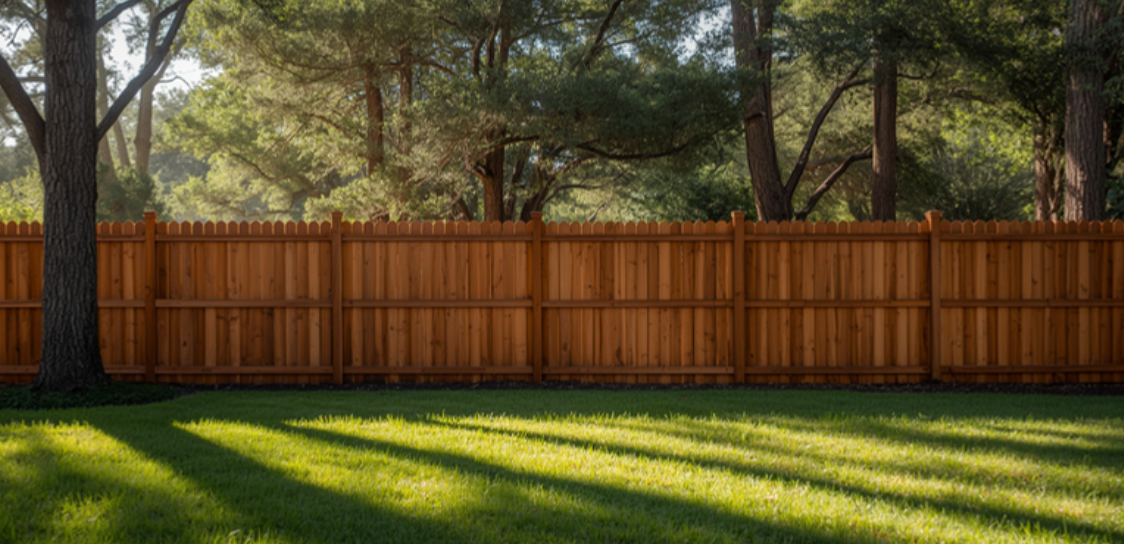
When Conroe homeowners outgrow a builder-grade side-by-side fence, the board on board vs. shadowbox fence question comes up fast. Both styles fix the main complaint about side-by-side pickets, the thin gaps that open as the wood dries in a Texas summer. Both use more lumber than side-by-side, and about the same amount as each other. The difference is what the fence does with that extra wood.
Here is how the two compare on the things that matter around Conroe, Willis, and Montgomery: privacy, wind, looks, upkeep, and the posts underneath.
How each style is built
Board-on-board starts with a row of pickets spaced a little less than one board width apart. A second row goes on top, centered over the gaps, so each board overlaps its neighbors. Both layers sit on the same side of the rails. The result is a solid wall of wood.
Shadowbox puts pickets on both sides of the rails, alternating. A board on your side covers the gap between two boards on the neighbor’s side, and the rail sits in between. Looking straight on, you can’t see through it. Look along it at an angle and you catch glimpses, and air moves through the offset.
| Factor | Board-on-board | Shadowbox |
|---|---|---|
| Privacy | Fully solid, even at an angle | Solid straight on, glimpses at an angle |
| Wind | Full load, acts like a sail | Some air passes, less load on posts |
| Look from each side | Overlapped face on one side | Identical from both yards |
| Lumber | More than side-by-side | About the same as board-on-board |
| Staining | Two faces, overlaps to reach | Two faces, plus board edges |
Privacy: the main reason to choose board-on-board
If the goal is to block every view, board-on-board wins. It suits a pool or hot tub area, a yard that backs to a road or trail, and the smaller lots in newer Conroe communities where the neighbor’s patio sits close to yours. Headlights and a dog that barks at everything it sees are other good reasons.
Shadowbox screens well enough for most backyards, but someone walking along the fence line will see movement through it. If that bothers you, don’t talk yourself into shadowbox for the looks.
Wind and the posts underneath
A solid six-foot fence catches every gust, and the posts lever that load into the ground. Shadowbox lets some air pass, so the same storm pushes less on each post. That is why our semi-privacy fences page points wind-exposed lots toward shadowbox.
Ground matters as much as style here. Most lots around Conroe, Willis, and Montgomery have 18 to 30 inches or more of loose sandy loam on top of a clay subsoil. Loose sand gives a post very little side grip, so gate and corner posts are the first to lean on either style, and they lean sooner on a solid board-on-board line. We set those posts in deeper, wider piers, belled at the base. Every post gets concrete, never gravel, with 24 inches and 80 lb of concrete as the floor on line posts. Our guide to setting fence posts in Conroe soil explains the full method.
Looks from both sides
Shadowbox has no back side. Both yards see the same alternating pattern, which makes it a natural pick for a shared property line, and neighbors tend to appreciate it. Board-on-board has a finished overlapped face on one side and the rails on the other, so you decide which way it faces. Many communities expect the finished face toward the street or common area, so the side that faces a greenbelt or street may not be your choice to make. Our HOA fencing page covers how we handle submittals.
Upkeep on shaded, pine-heavy lots
Both styles need a wash and a coat of stain every few years, and both have two faces to cover. On board-on-board, the overlap between layers can hold moisture on a shaded line, and pine straw likes to collect at the base. Shadowbox dries faster because air reaches every board, but it has more exposed edges, and stain has to get into the space between the two rows.
On a wooded lot that rarely dries out, shadowbox usually holds up a little better. On a sunny lot on a newer street, the difference is small and a regular stain schedule matters more than the style.
Cost
Because the two styles use similar amounts of lumber, the price gap between them is usually small compared with choices like cedar vs. pine pickets, fence height, or steel vs. wood posts. Expect either one to cost more than side-by-side. Your written estimate lists the style, materials, and posts separately so you can compare.
The practical takeaway
Pick board-on-board when full privacy is the point and the lot is fairly sheltered. Pick shadowbox for a shared line, a wind-exposed lot, or a shaded yard where drying matters. Either way, the posts decide how long it stays straight. If you want both priced on the same fence line, book a free estimate online. Call or text (713) 331-9419.
Questions
Quick answers
Can I switch from side-by-side to board-on-board on my existing fence?
Sometimes. If the posts and rails are sound, we can add a second layer of pickets over the gaps. Old rails that are already rotting or sagging should be replaced first, since the extra boards add weight.
Can a shadowbox fence keep a small dog in?
Yes. The boards overlap from either side of the rails, so there is no straight-through gap a dog can squeeze into. Diggers are a separate problem; a rot board along the bottom helps.
Can I build one style on the street side and the other in back?
Many owners do, as long as the heights and stain color match. Check your HOA guidelines first, since some communities name one style for any fence visible from the street.
Let's walk your fence line
Call or text us, or book a time online. We'll measure, talk through options, and send a written quote.