
Resources · 5 min read
How we set fence posts in Conroe's sandy-over-clay soil
Loamy sand on top, slow clay underneath. Here is how that ground shapes post depth, concrete, and gate posts on Conroe, Willis, and lake-area jobs.
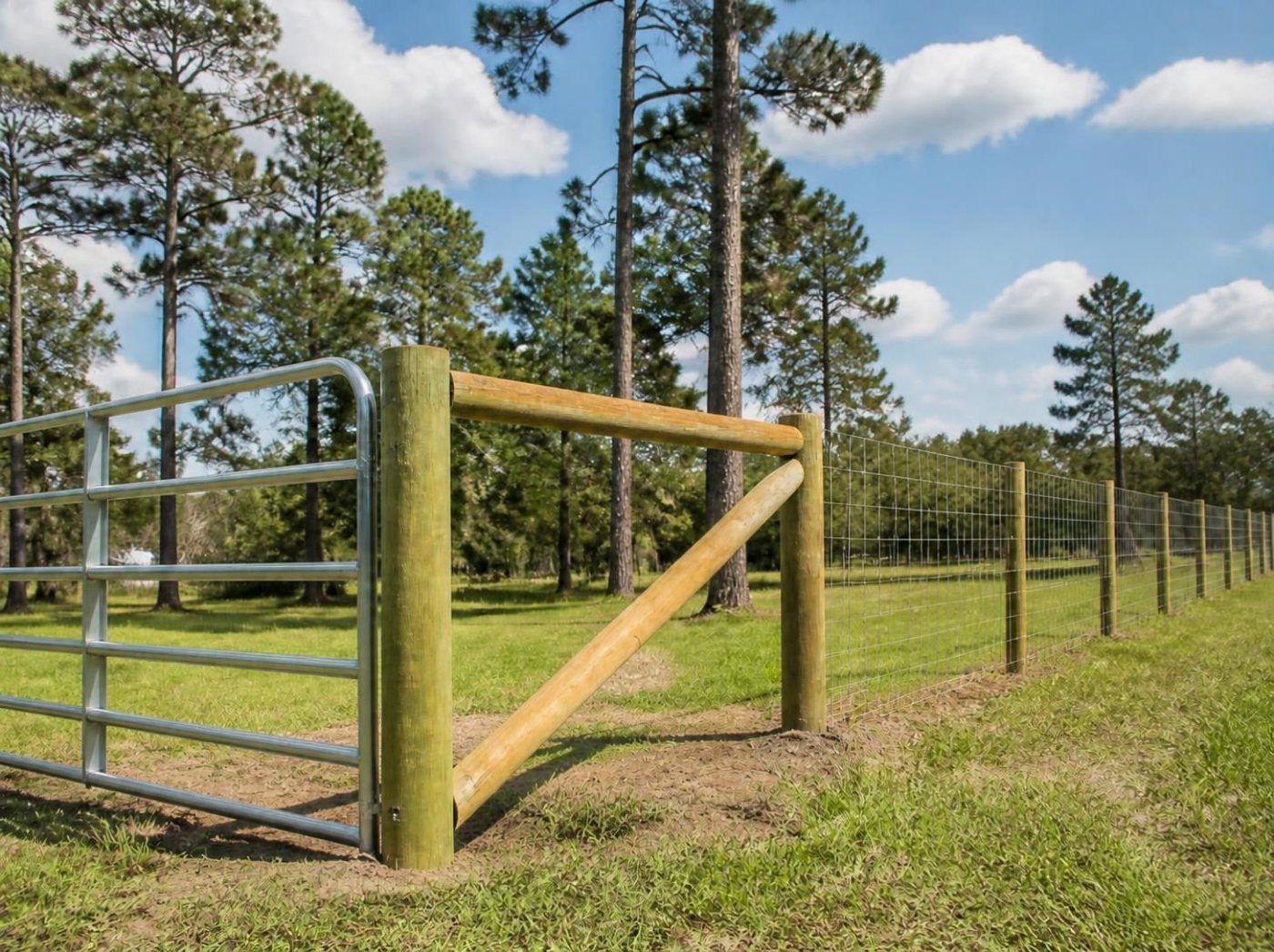
The ground under most Conroe yards isn't the sticky black gumbo people picture when they hear "Texas clay." Conroe loamy fine sand covers more of Montgomery County than any other soil type, according to NRCS soil survey data. Fetzer loamy fine sand, Splendora fine sandy loam, and Woodville fine sandy loam fill out the top four.
That has a lot to do with fence posts. Sand on top of slow clay behaves differently from either one alone, and most of the post failures we repair trace back to how a post was set in that profile. This page explains our method. If a post is leaning right now, start with our guide to fixing a leaning fence post.
What sits under a typical Conroe yard
The USDA's official description of the Conroe soil series lists a gravelly loamy fine sand surface over a subsoil of sandy clay loam to clay with plinthite, the reddish, iron-rich material that hardens into what crews call ironstone. The series is moderately well drained but has slow permeability. Its type location is in Montgomery County, and it was first described in Walker County, so the same profile carries north toward Huntsville.
Two practical results follow:
- The top layer gives a post little side grip. Loose sand lets a post rock in the wind, especially on a tall solid fence or at a gate.
- Water sits on the clay. After a heavy rain, water soaks through the sand and slows down when it reaches the clay. A post hole can fill overnight, and the base of a wood post can stay wet for days.
The clay in the Conroe series is a low-shrink type. Parts of the county do have heavier, more reactive clays, so we don't treat every lot alike. You can look up your own lot on the USDA Web Soil Survey.
Our baseline for depth and concrete
Concrete goes around every post we install. On wood fences, each post goes a minimum of 24 inches into the ground with 80 lb of concrete. That is the floor, not the target. In loose sand or ground that stays wet, we dig deeper or wider so more concrete bears against firm soil. When a hole reaches ironstone, we keep going rather than stopping short and calling it deep enough.
We finish the top of the concrete so it sheds water away from the post instead of leaving a cup that holds it. A rot board runs along the bottom of every wood fence we build unless the owner opts out, which keeps the pickets out of wet soil and mulch.
When a post hole fills with water
On flat lots, low backyards, and lots near the lake, we open holes and find water at the bottom more often than owners expect. Concrete poured into standing water mixes with it and cures weak. We get the water out before the pour. If a whole line is that wet, we talk with you about shifting the schedule or switching to steel posts.
A common call we get is a fence that went in during a wet week and leaned by the next summer. Checking each hole before concrete goes in is the cheapest fix there is.
Gate, corner, and end posts get their own spec
Line posts mostly hold the fence upright. Gate posts carry a swinging load every day, and corner and end posts take the pull of the whole run, which matters most on chain link and wire. Those posts go deeper with more concrete than line posts, and heavy wood drive gates or gates carrying an opener get the largest footings on the job.
Matching the post to the ground
| Ground we find | Where we see it | What we do |
|---|---|---|
| Deep, loose sand | Upland lots around Conroe and Willis, many wooded lots | Deeper or wider holes, with extra depth at gates and corners |
| Sand over shallow clay with trapped water | Flat subdivision lots and low backyards | Clear the water before pouring, shed water at the top, consider steel posts |
| Wet ground near water | East Lake Conroe shoreline lots, creek bottoms, Lake Livingston lots | Steel posts or open metal fence, with a layout that lets floodwater pass |
| Fresh fill or regraded soil | New-construction lots in Grand Central Park, Artavia, and Mavera | A deeper set, and a gate adjustment as the ground settles |
Galvanized steel posts behind wood pickets are an upgrade we offer where rot at the ground line is the main risk. They don't rot, and from the yard the fence still reads as wood. The wood and cedar page covers that option.
Roots, trees, and buried lines
Wooded lots add roots to the picture. We shift a post a few inches rather than cut a large structural root, and we keep posts off the trunk flare of trees worth saving. Before any digging, we put in a Texas 811 request, and we ask owners to point out private lines like sprinklers and landscape lighting, which 811 doesn't mark. Our Texas 811 answer explains what gets marked and what doesn't.
Want us to look at your ground before you choose a fence? Call or text (713) 331-9419. We note soil and water conditions at the estimate, and the written quote spells out post depth and concrete. For the short version, see why fence posts fail.
Questions
Quick answers
Are steel posts better than wood posts around Conroe?
Steel can’t rot, and the soil line is the spot where most wood posts give out around here. Galvanized posts cost more up front, and they can sit hidden behind wood pickets.
How deep should a post be for a 6 ft fence?
Our wood-fence minimum is 24 inches with 80 lb of concrete. We add depth or width in loose sand or soggy spots, and gates and corners get more than that. There is no single right depth for the whole county.
Do you ever set posts in gravel instead of concrete?
No. All of our posts are set in concrete. What changes from lot to lot is the depth and width of the hole.
Let's walk your fence line
Call or text us, or book a time online. We'll measure, talk through options, and send a written quote.