
Resources · 4 min read
How wide should a fence gate be? Size it for what goes through
A gate that's a few inches too narrow gets cursed at every week. Here is how we size walk gates, mower gates, and boat or trailer gates around Conroe.
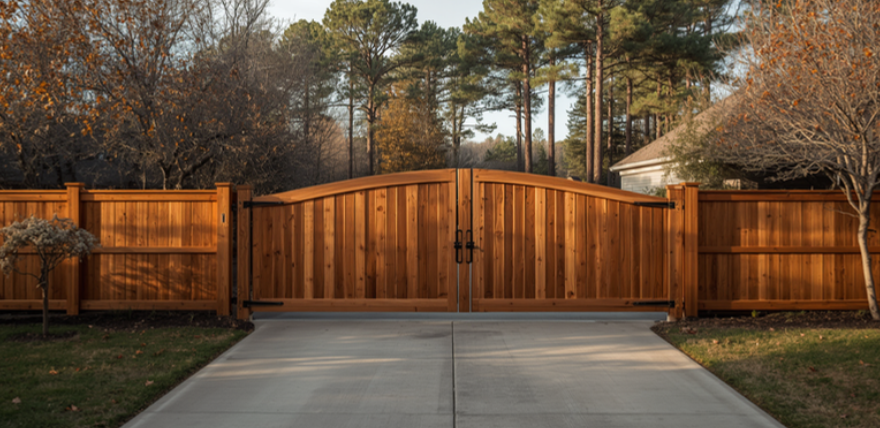
How wide should a fence gate be? Wide enough for the biggest thing that will ever go through it, plus room to spare. That sounds obvious, but the most common gate complaint we hear around Conroe, Willis, and Montgomery isn't sagging. It's a side gate the new riding mower won't fit through, or a boat gate that clears the trailer by an inch on a good day.
A gate is cheap to size right on day one and expensive to widen later. Here is how we think through it at the estimate.
How wide should a fence gate be? Start with a list
Before picking a number, list everything that will pass through each gate over the next ten years, not just this summer. Then measure the widest one at its widest point.
- People, pets, and trash carts. A standard walk gate handles these with room left over.
- Push mowers, wheelbarrows, and wagons. A 4-foot walk gate fits most of them.
- Riding mowers and zero-turns. Decks commonly run 42 to 54 inches, and some are wider. Measure with the discharge chute down, since that is usually the widest point.
- Cars, trucks, and trailers. These need a drive gate, and the right width depends on how you approach it as much as on the vehicle.
On a boat trailer, the widest point is often the boat, not the trailer. Measure the beam and any guide-ons, then add room for a mirror and a less-than-perfect line.
Walk gates and mower gates
Four feet is a common starting point for a walk gate, and it fits most push mowers. If a riding mower lives in the backyard, size that gate to the mower plus several inches per side. A 5- or 6-foot single gate often does it. Past that, a single wood leaf gets heavy, and heavy single leaves are the ones that drop at the latch side. Our sagging gate guide explains why.
On the 45- to 60-foot lots common in newer Conroe subdivisions, the side yard between houses is often the limit. Check the space between the fence line, the AC pad, and the gas meter before you settle on a width.
Drive gates for trucks, boats, and trailers
A straight-in drive gate can be closer to the vehicle's width than one you have to turn into. If you pull off a narrow street, swing in from a side driveway, or back a trailer around a corner, the trailer cuts inside the truck's path, and the opening needs to be noticeably wider. A 12-foot opening is a common choice for a truck and trailer coming straight in; turns, tractors, and hay equipment push that higher. On acreage around Montgomery, or wooded lots like those in Red Oak Ranch south of Conroe, a 14- to 16-foot entrance is common where farm equipment comes and goes.
Lake lots are their own case. In Seven Coves and Point Aquarius, the side gate is often how the boat gets from the driveway to the backyard. We size those gates to the boat and the turn, not to a catalog width.
One leaf or two?
For openings of about 10 feet and up, two leaves are usually the better build. Each leaf hangs on its own post, so neither has to carry the full width. The inactive leaf needs a drop rod and a sleeve in the ground to hold it. Where a driveway slopes up toward the gate, or there isn't room for the leaves to swing, a slide gate on a track along the fence is often the cleaner answer.
Wider gates need stronger posts
Every extra foot of gate adds weight and leverage on the hinge post. That matters on our ground. Upland lots around Conroe, Willis, and Montgomery typically have 18 to 30 inches or more of loose sandy loam over a clay and plinthite subsoil. Loose sand doesn't grip a post sideways, so gate posts are the first to lean.
We set gate posts in deeper, wider piers than the line posts, belled at the base so the footing locks into firmer ground. Every post goes in concrete, never gravel. On wood fences the floor is 24 inches and 80 lb of concrete per post, and gate posts get more than that. If a hole takes on water, we pump or bail it out before the pour. Our guide to setting fence posts in Conroe soil goes into the details. Heavy or wide gates often get steel posts and a steel frame under the wood face as well.
Plan for later, not just today
A gate you might automate someday should be built for it now: a frame strong enough to carry an opener, posts sized for the motor, and a clear path for the swing or slide. Our gates page covers the hardware side. The same goes for the boat you plan to buy or the tractor that comes with the acreage. Widening an opening later means new posts, new concrete, and a new gate, while a few extra feet at install time costs little by comparison.
Not sure what width you need? Tell us what you drive, tow, and mow, and we'll measure the approach and lay out the gates around it. Call or text (713) 331-9419, or book a free estimate online.
Questions
Quick answers
Can you widen the gate on my existing fence?
Usually, yes. We cut the opening wider, set new gate posts in deeper, wider concrete footings, and build a new gate to fit. The old gate posts are rarely worth reusing, since they were sized for a lighter gate.
Should a side gate swing in or out?
Most side gates swing into the yard, so they don’t block a walkway or driveway when open. Pool gates are the exception and follow their own rules; see our pool enclosure page.
Does my HOA care how wide my gate is?
Some associations review drive gates and double gates separately from the fence, especially on the street side. Put the gate width and style in the submittal. Our HOA fencing page covers what to include.
Let's walk your fence line
Call or text us, or book a time online. We'll measure, talk through options, and send a written quote.